Saturday, August 28, 2010

A Culinary and Other Adventures in Kalamazoo, Michigan


It's been a while since I wrote my last blog in this site, and I am excited to be back, writing about food, cooking and other adventures once again. My daughter and I have arrived in this small, sylvan mid-Western city on Thursday morning after a 24-hour dash from Denver, Colorado in which we covered more than 1200 miles passing through Nebraska, Iowa, Illinois, and part of Indiana.


We arrived at my friend's house in Kalamazoo at around 7:15 in the morning. Dr. Gus Guerrero and his wife, Ann, and their three girls have lived in this beautiful city 160 miles west of Detroit for about 20 years, in a beautiful house that they had built in a leafy, small-scale development just off the I-94, a major West-to-East corridor in Michigan. There are no Asian and Filipino supermarkets close by. Being Angelenos for most of 25 years, and having all those Asian supermarkets within 3 miles of our home in the Los Angeles suburb of Glendale, it would be difficult for me to prepare my classic Filipino cuisine here as I have done in the past years in California. I tell Gus and Ann that I would love visiting and exploring a city like Kalamazoo, but not live in it.


Last night, after we returned from Lake Michigan, in the small town of South Haven, Ann was braising two large venison steaks that she had marinated with soy sauce, lemon juice, salt and pepper, and left in the fridge overnight. I did not know that Gus, who knew that I love venison, had acquired the meat from a source and asked Ann to make sure that I have an opportunity to savor them. Venison is a luxury in California because deer is harder to bag there than in a heartland state like Michigan, where there is a vibrant hunting tradition and where deer and other wild game are plentiful.


Gus pops open two bottles of Bell's Oberon beer, rated one of the ten best beers in America, and brewed right here in Michigan, and together we saluted life with thin slices of venison and bowls of sotanghon soup with the rest of his family. My daughter, Justine, whose food choices are limited to non-exotic meats, opted instead to finish off a plate of spaghetti and meatballs. The way that the venison was marinated was perfection -- and very familiar because the ingredients are the exact, same ingredients Filipinos use when cooking bistek, minus the caramelized onion rings. There's no gaminess at all in the venison.


I used to get my venison from South Carolina, usually shipped to Glendale, already cured and ready to cook. My older brother, Leo, who had lived in Yemassee, South Carolina for many years, hunted and/or procured venison from his hunting buddies there, and whenever he would have a cache, he sent me more than enough salted venison for me to consume. I gave some away to my venison-eating freinds in Los Angeles. Venison is healthier than beef; it is very lean, like bison meat, and you can cook and eat it in ways that you cook beef. Ann tells me that a friend of theirs never have to buy beef and other meats because they have a constant supply of venison in the freezer. Her friend is a hunter and one of Gus's partners at Physicians Center of Physical Medicine in Portage, MI.


I met Gus, a native of Cagayan de Oro, in the Southern Philippines, in the early 1970s. He was then taking up Medicine at the University of Santo Tomas, the oldest Catholic university in Asia. We had the same passion for the outdoors, and we scaled some of the major peaks in the Philippines, sharing our adventures in words and pictures with magazines of the day. He is a trailblazer in Philippine mountaineering, having been the first Filipino on record to scale the rock face of Mt. Maculot in the province of Batangas. The way he tells it, after running out of drinking water, while dangling some 1000 feet above a lake, he was forced to drink his own urine to alleviate thirst. He wanted to be a forest ranger as a career. His father, helped him make up his mind, and he acquiesed to his dad's admonition that he would be better off with a medical degree.


Gus, with four doctor partners, practices orthopaedic medicine in Kalamazoo. He had finished his residency in a hospital in Cleveland, Ohio, and like all foreign doctors, had to move up the ranks through the years. His beautiful home here, a successful practice, three beautiful girls who are leaving Michigan to pursue higher education in other states -- San Diego, California for Amber, Cleveland, Ohio for Lhotse, and Chicago, Illinois for Leslie -- are clear manifestations that my friend has truly made it in America. "Now it's payback time," he tells me while we are touring Kalamazoo College, where Amber had finished her 4-year undergraduate degree.


On Monday, my daughter and I will drive northeast to Toronto, and then view Niagara Falls from the Canadian side. More advertures are in the horizon. Till next time.

Friday, January 29, 2010

An Evening of Food and Music at the De la Cruz Home


This is a self-imposed assignment: rate the food and the music served up at the mid-city home of my friend and colleague Prosy de la Cruz and her husband, Professor Ike de la Cruz. I would be more at ease rating the entrees that home chef Prosy spent the whole day preparing, but I do not feel that I have the expertise to comment on the music, which was offered up by an impressive group of Fil-Am musicians. (But I will throw in my five cent's worth, anyway). The musicans are top-shelf caliber. Four are members of the newly-constituted Filipino-American Symphony Orchestra (FASO), an operatic singer, and a pianist who is also a physician.

Prosy had worked up a sweat preparing the entrees for last Thurday evening's soiree. They consist of a sotanghon-chicken soup, a lettuce-cabbage-chicken salad, braised filet mignon steaks, steamed brocolli tips with shaved Italian mozarella cheese, and a gigantic wild salmon (around 20 lbs.) baked to perfection; and for dessert, iressistible cream brulee. Prosy's take on the sotanghon-chicken soup is quite unique, not so much for the taste, but for the preparation. The chicken pieces are chunky (not pulled), a la chicken arroz caldo, and it is topped with spinach, and made richer with an ample amount of ginger strips. Prosy tells us that she used less sotanghon (cellophane noodles) to reduce the carbohydrate content of the soup; that way we could make room for the steamed rice. When she e-mailed me the invitation, she modestly told me that she would only cook a salmon. So my wife and I came in not expecting a huge feast.

The filet mignon, already baked to doneness, benefitted from a brief braising in a soy sauce mix, making them more tender and really acceptable to Pinoy palates that do not favor meat baked rare. I forego the salad in favor of the brocolli tips, and I dabble a few spoonfuls of the filet mignon's sligthly fatty gravy on my steamed rice. Then I cut a little rectangle of salmon meat from the salmon's belly, and I am good to go.

At the dining table that Ike and Prosy set up in the study I find myself face-to-face with Jamie Lazzara, the evening's special guest. Jamie is a master violin-maker who is vacationing from her violin-making shop in Tuscany, Italy. Jamie is a born-and-raised Southern Californian from Pomona. When she was 19 years old, she had wanted to be a violin-maker, and she had made that known to the owner of a violin store in Long Beach. But to her disappointment, she was told that girls do not belong in the violin-making craft. Jamie hied off to Cremona, Italy, where she attended a violin-making school. She completed the four-year course and arrived at her dream.

Jamie is a very tall girl. If she were to play women's basketball, she would be a center. But, fortunately for the music world, she decided to be a violinist and violin-maker instead. When she told us that it took four years to learn how to be a violin-maker, I was astonished. Did they have a subject on wood selection, or how to wield a carving knife and a wood saw? How to age European spruce and maple woods? Surely, her four-year investment in time and money is now paying off. She makes four violins a year, at around $11,000 each. Not that many. But if you consider how much each Lazzara violin costs, it's a huge deal, indeed. Professor Ike de la Cruz, who teaches Asian-American Studies at California State University, Northridge (CSUN), can attest to this. He bought a violin from Jamie, and from what I hear, it occupies a revered station in the De la Cruz household, probably next to Prosy's home-cooking.

Ike tells us that his Lazzara violin had been with him on vacations in various places in North America, and last year, when he and Prosy vacationed in Manila, the Lazzara went with them.

Ike is so privileged to own a Lazzara as he is in great company, like world-reknowned American violinist Itzhak Perlman, who played a Lazzara violin at President Barack Obama's inauguration last year. As Jamie tells us, it was ten degrees below zero, and Perlman did not risk using his Stradivarius because the extreme cold could have cracked it. Besides, no violinist in his right mind would treat a centuries-old Stradivarius like a cheap, commercial grade one. Jamie claims that Italian violins are solely made of European spruce and maple for their stability.

Tenor Christopher "Pete" Avendano arrives and I introduce him to pianist Dr. Charito Sison, a friend of the De la Cruzes. I tell her that Pete was lead in the original cast of opera "Karim at Jasmin", written by librettist and composer Dr. Ramon Sison-Geluz (no relations to Dr. Sison). There is instant connection between the two musicians, and I can tell they would sing and play soon.

I conclude my satisfying dinner with a serving of cream brulee, then I get ready for the musical treat that is coming in a few minutes. Prosy calls it jamming. Musicians can be likened to photographers and artists. Gather them together and they would talk shop at the drop of a hat. This coterie of musicians is no different: they are eager to jam. Musicians do not have to know each other; they only need their instruments to communicate with each other. The product is spontaneous music that touches one's soul. FASO director Bob Shroder whips out a flute; guitarist and Charmaine Clamor accompanist Rick Ickard hauls out a unique 7-string acoustic guitar; and violinists Lito Molina and Andy Tecson share the use of Ike's Lazzara violin. Tenor Pete Avendano unleashes his major pipes; and Dr. Charito Sison tickles the piano keys. Ike and Prosy's Yamaha piano and their house's excellent acoustics complemented the slowly building crescendo.

The stage is set for an evening of enchanting music: kundiman, opera, classical, folk, jazz and bossa nova. This is a major entertainment and culinary occasion. I would have kicked myself if I missed the opportunity to be here.

Pete is a sensatiion with his soaring tenor which he calmly utilized to negotiate the peaks and valleys of a whole gamut of musical genre, from kundimans to opera. Bob Shroder, Ric Ickard and Lito Molina collaborated on a bossa nova composition of Antonio Carlos Jobim; each musician exhibiting his virtousity. Giovanni, Jamie's Italian companion, indulged us with an a capella rendition of a bawdy Italian folk song that Jamie interpreted in English. Jamie played two Italian folk songs on Ike's violin, and Ike performed a kundiman, accompanied by Dr. Sison and Pete. There are numerous unforgettable musical numbers, and many more that my wife and I missed because we had to leave before the soiree ended.

The evening was an absolute success, from what I have seen and heard. Everything from the delicious dinner to the hospitality of the De la Cruzes, to the music performed by excellent musicians, are winners. As for Prosy's home-cooking? They made me a believer in her passion and dedication to the culinary arts. Here's a toast to foodies everywhere!

Friday, January 22, 2010

Music Versus Food at the Prosy and Ike De la Cruz House


This is a tough one to arbitrate. Music versus Food. Treats for the ears versus treats for the stomach. It happened Thursday evening at the mid-city home of Prosy de la Cruz and her husband, Professor Ike de la Cruz. I find myself deciding this poser: who wins, Prosy de la Cruz's cuisine or the music played by an impressive collection of musicians: an accomplished Italian-American violin-maker based in Florence, Italy; an operatic tenor; a medical doctor who is also an acomplished pianist; and four musicians that belong to the Filipino-American Symphony Orchestra (FASO)?

Home chef Prosy had worked up a sweat preparing the entrees for the evening. It consist of a sotanghon-chicken soup, a lettuce-cabbage-chicken salad, braised fillet mignon steaks, steamed broccoli tips with shaved Italian cheese, and a gigantic wild salmon(around 20 lbs.) baked to perfection; and for dessert, sinful cream brulee. Her take on the sotanghon-chicken soup is quite unique, not so much for its taste, but for its preparation.The chicken pieces are chunky, a la chicken arroz caldo, and it is topped with spinach, and made more savory with an ample amount of ginger strips. She says that that she used less sotanghon to reduce the carbohydrates, and to make room for the steamed rice. The baked fillet mignon benefitted from
a brief braising in soy sauce and the beef's natural fat and juices, making the steak reach a degree of doneness that is most welcome to most Filipino palate. I forego the lettuce-cabbage salad in favor of the brocolli spears, and I dabble a few spoonfuls of the fillet mignon's gravy on my steamed rice. Then I cut a little rectangle of meat from the salmon's belly, and I am good to go.

I go to the dining table that the de la Cruzes et up at the study and find myself face-to-face with Jamie Lazzara, the violin-maker. Jamie was born and raised in Pomona, and when she was 19, she had made her dream to become a violin-maker known to the owner of a violin store in Long Beach. To her consternation, she was told that girls did not belong in that trade. So she hies off to Cremona, Italy, where she attended a school of violin-making. She completes the four-year course and followed her dream. Jamie is a very tall girl. If she were to play women's basketball, she would be a center. But fortunately for the music world, she decides to be a violin-maker and violinist instead of a basktball player.

I can't imagine how it takes four years to learn how to make a violin. But then again, I have not seen a million dollars. Did they have a subject on wood selection? Wood Selection 101, or Using a Knife 201, or how to age European maple and spruce? Surely, her four-year investment is paying its dividends today. She makes four violins a year. Not too many. But if you consider the fact that each of her violins costs a whooping $11,000, it's a huge deal, indeed. Professor Ike de la Cruz, who teaches Asian-American Studies at the California State University-Northridge, can testify to this. He bought a Lazzara violin from Jamie, and it occupies a revered station in their household, probably next to Prosy's cuisine. Ike says that his Lazzara had been to Manila and in some of his family's vacations in various places in North America. Ike is so lucky to own a Lazzara. It is like owning an expensive Mercedes Benz or a BMW. As soon as Jamie had listened to Ike's violin, she tells him it needed some fine-tuning. She immdediately works her magic on Ike's violin. The tune-up is akin to tweaking an expensive car to attain a faster top speed.

While Ike is still learning how to improve as a violinist on his Lazzara, more accomplished violinists like Itzhak Perlman, had already recognized the Lazzara violin. Perlman used one of Jamie's violins during his performance last January at the inauguration of President Barack Obama. As Jamie tells it, it was ten degrees below zero during Obama's inauguration, and Perlman would not risk taking out his Stradivarius because the intense cold could have cracked it. Besides, no violinist in his right mind would treat a centuries-old Stradivarius like a Chinese-made violin.

And speaking of Chinese-made violins, Ike says that he had heard some of them played, and says they are "loud", and can be had for as little as $400. In fact, perusing the Music section of eBay a few years ago, I found a second-hand violin for less than $100. Maybe that was made in China. Jamie says that Italian violins are made of European woods, specifically European maple and spruce. I surmise for their stability.

Tenor Christopher "Pete" Avendano arrives and I introduce him to Dr. Charito Sison, a physician- pianist friend of the De la Cruzes. She learns that Pete is a tenor and tells him that she had brought a few music sheets of some Filipino kundimans, some composed by her late husband, Ramon Sison, who was a medical doctor, musician and composer. I see a duet forming here. I tell her that Pete was lead singer in the first Filipino opera, "Karim at Jasmin", written by librettist and composer Dr. Ramon Sison-Geluz (no relations to her). I knew they would play and sing together after dinner.

I conclude my dinner with a cup of cream brulee that I heard was being served in the kitchen, then I prepare myself for a musical treat;an impromptu concert, if you will. Prosy call it jamming. Musicians are pretty much like artists and photographers. Well, more like photographers. Gather them together and they will make music, even unrehearsed. Gather a handful of photographers, and they will talk endlessly about the virtues of this or that camera, for hours on end. The musicians do not need to know each other. They only need to know how to play their music instrument. FASO director, Maestro Bob Shroder came with his flute, and the FASO guitarist, with his 7-string guitar, and Pete Avendano, his vocal cords. Prosy and Ike have a Yamaha piano, and their beautiful wood-floored house has excellent acoustics.
The stage is set for a night of jazz, classical, and folk music.

Pete Avendano is a hit, with his major pipes easily negotiating the highs and lows of a Filipino kundiman with Charito Sison. Bob Shroder and a FASO guitarist and a violinist collaborated on a Antonio Carlos Jobim bossa nova number that transports us to the 60s; and Giovanni (Jamie's Italian friend) performs an irreverent Italian fok song, a cappella, which Jamie translates. There are many, unforgettable numbers, and probably many more that my wife and I missed, as we had to leave before the soiree ended.

There are no losers. Everything from the dinner to the hospitality of the De la Cruzes, to the different music genres performed, are winners. As for Prosy's the gastronomic creations? They made me a believer in her passion and dedication to cooking.

Saturday, November 14, 2009

How Would You Like to Wok Around Binondo?


On October 19 I went to the Binondo district of Manila for a second time during my one-month working vacation in Manila. This time around, I was with a group of food writers and editors that included chef Claude Tayag of Bale Dutung, and the editors and staff of Food Magazine. Earlier, I had e-mailed Claude and his lovely wife, Mary Ann, asking if I could tag along, and he said, "sure." That makes me the accidental (food) tourist in this group.

The tour group met at the centuries-old Binondo Church on the corner of Ongpin St. and Reina Regente, in the heart of Manila's Chinatown. A stone-throw's away is the Eng Bee Tin Hopia factory and restaurant, one of the stops that organizer Old Manila Walks calls "The Big Binondo Food Wok," a romp around the district, visiting and sampling food from close to ten small restaurants and eateries.

It is amazing to note that having lived in Manila for half of my life, I was not aware of some of these restaurants in Binondo. For one, we Pinoys patronized well-known and household name restaurants like Panciteria de Santa Cruz, Panciteria San Jacinto, Smart, etc., not aware that there are other, smaller, but truly Chinese restaurants in the heart of Binondo, in streets like Yuchengco and Carvajal, the latter is more an alley than a street. Here, there is one small eatery called Quick Snack, founded by a Chinese woman who originally came from Indonesia. Hence, the cuisine at her eatery is influenced by Indonesian cooking.

Knowing that we would be sampling food in number of restaurants, I made sure to eat as little as I could to make room for an eight-hour food binge. Here I sampled a spicy noodle dish, whose Chinese name I did not care to put to memory because it is either unpronounceable or difficult to spell. But the verdict for that noodle dish is: it is too foreign for my taste. A taste that had been cultivated by Macao or Hong Kong-style Chinese cuisine.

Our second stop is Sincerity Cafe on Yuchengco St. It's been in that location since 1956, and I never heard or seen it! Walk organizer and historian, Ivan Man Dy tells the group that this restaurant is well known for its fried chicken. Here we were served kikiam, fried chicken, and oyster cake, requested by Chef Claude. Sincerity's version is held together by a tapioca flour base, and as a result, it was quite heavy. We would discover that another version that we would soon eat at another stop, would be lighter and better-tasting than this one. I didn't enjoy this version very much. For one, I did not get the taste of fresh oysters, and secondly, like I said before, it was too heavy due to the tapioca base.

It was around noon when we got to our fourth or fifth stop at Eng Bee Tin Hopia factory and the small restaurant that it operates on the second floor. Here, we were regaled with the presence of Jerry Chua, owner of Eng Bee Tin, who related to us his hopia factory's rise to the number one position in the industry. Jerry is an active member of the privately-owned Chinese volunteer fire brigade in Binondo, and he tells us that he became more known as a member of that fire engine company before he made his name in hopia-making. He has a penchant for making light of himself and his hopia-making expertise. After his talk, he gave everyone a bag of three different versions of the Eng Bee Tin Hopia. I became addicted to the langka-ube combination.

From Eng Bee Tin, we visited a Chinese Drug Store, Bon Shiang Thay. "Chinese medicine is more on prevention," explains Ivan. It's about balancing the body. Like if you have fever, do not eat chocolate, because it packs heat." Then we crossed the street to another small restaurant that specializes in dumplings that are common in Fujian, a province in the Southern part of China. We were served sio mai, which, according to Ivan, is the most common dumpling of all. When we entered the restaurant, two restaurant workers were kneading dough near the front door, in view of all the diners, while the owner, a shy Chinese woman, gave us the 411 on the origin and prepatiion of the dumplings. "Every region of China has its own version of dumplings, " says the Chinese woman. "We are making northern-style dumplings with ground meat as filling."

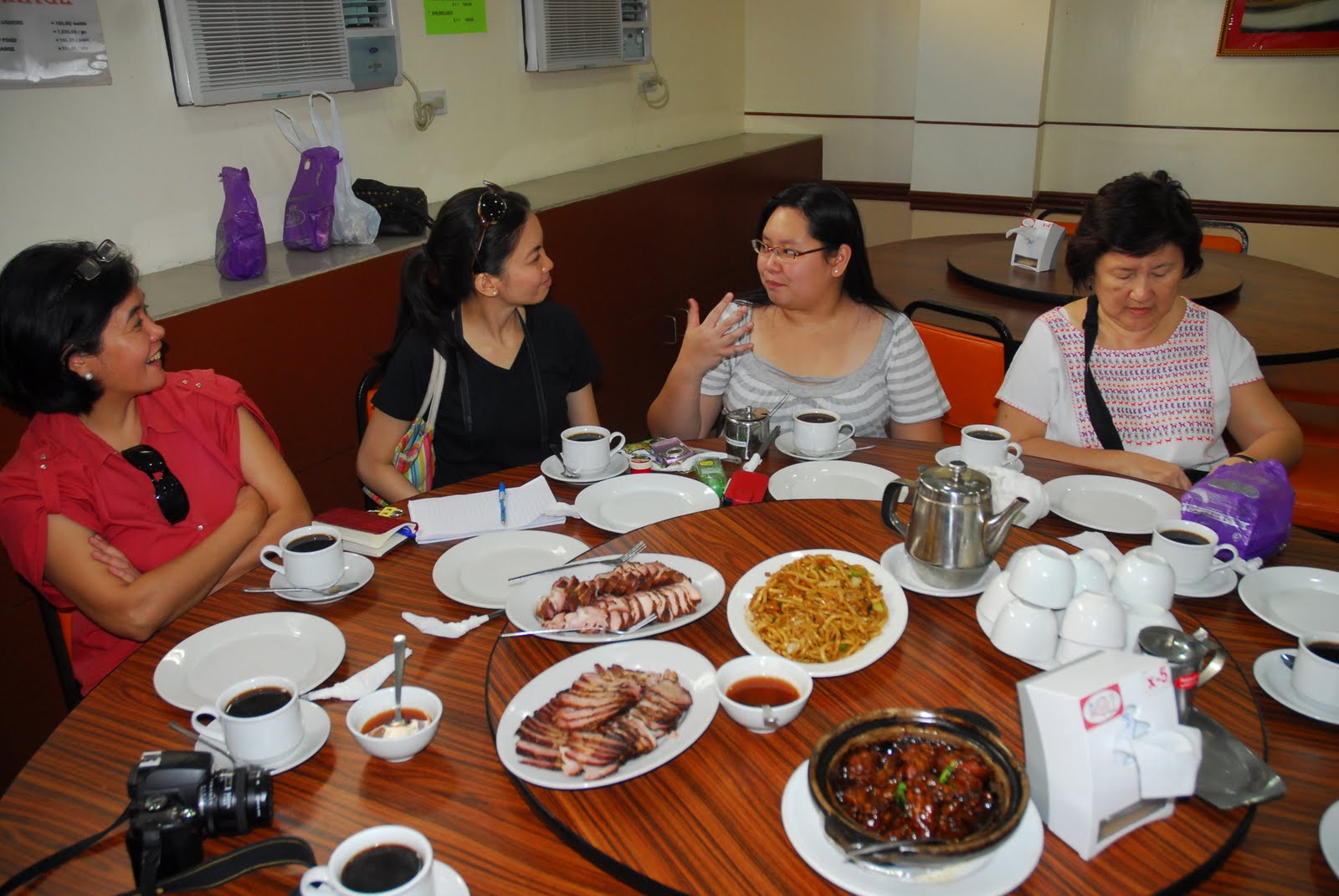
There is something peculiar about Sa Lido Restaurant. It's perceived as an all-male restaurant, at least before our group arrrived that afternoon. The eatery is located on the second floor, and when we arrive a small gathering of elderly men are already there, smoking, drinking coffee and tea, and talking animatedly. They are "akongs" (elderly Chinese men), according to Ivan. They do not eat a whole lot, but congregate at Sa Lido more as a male bonding tradition. Here, they hold court, talking about what men talk about when their wives and other women are not around. Sa Lido's distinction is "asado" or oven-roasted pork loin that I have known as a young boy. It is one of my favorite Chinese dishes growing up, and is up there with "pancit canton" (chow mein) and "hototay" (pork and vegetable soup).

Our last stop is Masuki (literally, small horse). It was established in 1960, and specializes in mami and sio pao. Before we were served our mami and sio pao, the manager, Willen Ma, daughter of the founder, took us to second floor where one of the hands demonstrated how mami noodles is prepared the old-fashioned way (manually kneading the flour, eggs and water), then feeding the dough to a noodle machine (automated). On they way there, we also passed the kitchen where the sio pao fillings are prepared, and where the mami noodles are dunked into vats of boiling water, prior to serving. It was an altogether interesting but elaborate demonstration. But I doubt if that heightened my appetite for mami. For one, this was our last stop, after a long list of other eateries -- and I, for one, was stuffed up to my larynx. For another, I am not a big fan of mami. So when it comes time to eat, I just tackle a half of a large sio pao. It is excellent, but being flour-based, quite heavy.

All in all, the all-day walking and food sampling tour of Binondo was a mixed bag for me. Of all the dishes we sampled, I would say that I enjoyed about half, and that includes the humble fishball soup that I had at Eng Bee Tin, the pata tim and the asado at Sa Lido, and the boiled beef with radish, and the oyster cake at another. I grew up on Macao or Hong Kong-style Chinese cuisine, eating with my family at restaurants like Panciteria San Jacinto, Panciteria de Santa Cruz, and Smart Restaurant in Manila. But these establishments are no longer there today. San Jacinto had moved to Pasig City, and the two others have either closed or moved elsewhere.

The tour was more than a culinary tour of bacchanalian proportions. It was a trip back in time in Manila's Chinatown.